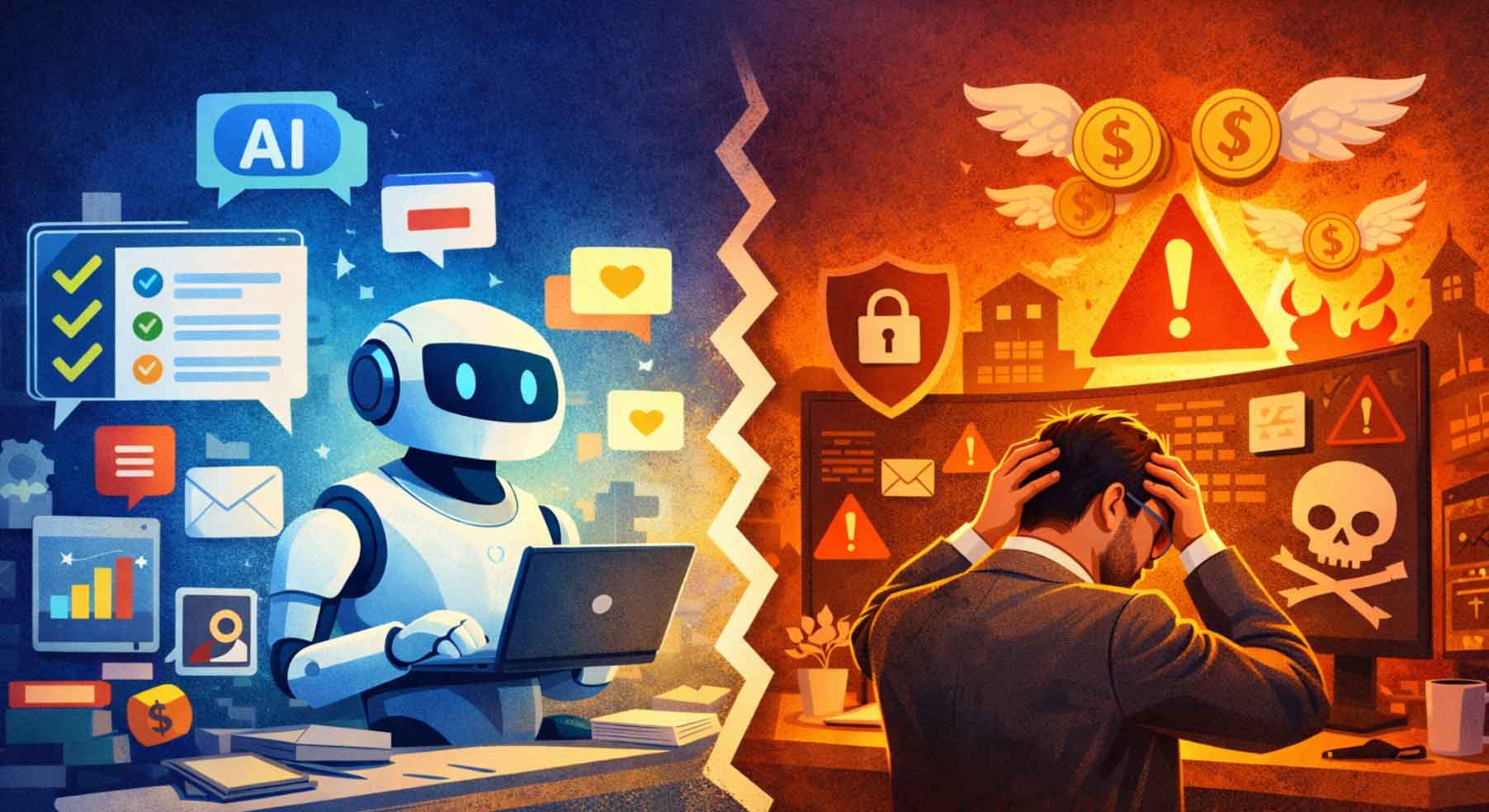
Where AI Actually Helps Small Businesses – And Where It’s Mostly Hype
Artificial intelligence is everywhere right now. Every platform claims it will save time, reduce costs, and “automate” growth. For small business owners, that promise is tempting—because time and money are always tight.
The issue is that most AI talk is driven by vendors, not by people who actually have to run a business, manage staff, and close sales. So let’s strip it down: here’s where AI genuinely helps small businesses today—and where it’s mostly hype.
Where AI Actually Helps Small Businesses
1) Speeding Up Repetitive, Low-Value Work
AI is excellent at handling tasks that are necessary but not strategic—especially when you already know what you’re trying to say and just need to move faster.
- Drafting first-pass emails
- Summarizing meeting notes
- Turning bullet points into a rough draft
- Rewriting content for different formats (blog → social → email)
- Creating quick checklists and internal documentation
The key distinction: AI doesn’t replace thinking—it accelerates execution once the thinking is done.
2) Content Support (Not Content Strategy)
If you’re a small team without an in-house writer, AI can help you keep consistency without burning hours. It’s great for:
- Improving clarity and structure
- Generating headline variations
- Expanding notes into readable paragraphs
- Repurposing one idea into multiple posts
What it can’t reliably do is decide what you should publish, why it matters to your audience, or how it ties into a
sales process. That still requires customer understanding, positioning, and timing. AI is the assistant here—not the creative director.
3) Research and Pattern Recognition
AI can quickly surface patterns, themes, and questions—especially when you feed it real inputs such as FAQs, reviews, support tickets, or call notes. It can help you:
- Identify common customer questions
- Spot recurring objections
- Cluster content topics (what you should write about next)
- Compare competitor positioning at a high level
This is valuable when paired with real-world experience. AI can show you patterns; it can’t tell you which ones matter. Judgment is still human.
4) Internal Efficiency and Operations
Some of AI’s best ROI is invisible to customers but extremely valuable internally:
- Drafting SOPs and training material
- Standardizing responses (without sounding robotic)
- Creating onboarding checklists for staff
- Reducing the “where is that file / info?” chaos
These aren’t flashy wins—but they reduce friction, errors, and burnout. Over a year, that adds up.
Where AI Is Mostly Hype
1) “Set It and Forget It” Marketing
Tools promising fully automated marketing funnels, social calendars, or ad strategies rarely deliver meaningful results without oversight. Marketing isn’t just output—it’s positioning, timing, nuance, restraint, and response to what’s happening in the market.
Left unchecked, AI-driven marketing tends to be louder, not smarter. You get more posts, more words, more “activity”—but not more results.
2) Replacing Sales Judgment
Sales is context-heavy. It involves reading hesitation, understanding objections, and knowing when to push – or back off. AI can help draft a follow-up, but it can’t reliably judge:
- When a prospect is stalling vs genuinely busy
- When price is the real objection vs a smokescreen
- When to simplify the offer vs expand it
Any tool claiming it can “close deals for you” should be treated with skepticism. You still need a human who understands how decisions are made.
3) AI-Generated Websites That “Convert”
AI can generate a website quickly. What it cannot do well is align your messaging, visuals, trust signals, and calls-to-action with the way your customers actually buy.
A fast site that doesn’t convert is just a faster way to waste traffic.
4) AI as a Replacement for Strategy
This is the most dangerous hype. Strategy requires trade-offs. AI generally tries to please everyone and avoid hard decisions unless you give it constraints and direction.
If AI is driving your strategy, you don’t have one.
Two Real-World Examples (What “Good AI” Looks Like)
Example 1: Turning Real Sales Conversations Into Content
A service business owner had plenty of expertise but struggled to publish consistently. Instead of asking AI to “come up with content,” we used real inputs: the last 10 customer questions they received and the top objections heard on calls.
AI helped organize those into a simple content plan: a short FAQ page, three blog topics, and a set of quick social posts. The strategy and positioning came from the owner’s experience. AI reduced the time it took to get it into usable form.
Example 2: Stabilizing a Website Under Attack
After repeated malicious traffic impacted performance and reliability, Cloudflare protection was added at the server edge to reduce strain and improve uptime. AI wasn’t the solution—but it did help speed up internal documentation, create client-facing explanations, and standardize support responses so the team could communicate clearly and move faster.
The Real Opportunity
The businesses getting value from AI right now aren’t the ones chasing every new tool. They’re the ones asking better questions:
- Where am I spending time that doesn’t move revenue?
- Where could speed give me leverage?
- What decisions must remain human?
- What work needs judgment vs execution?
AI works best when paired with experience, not when used to replace it.
Bottom Line
AI is not a shortcut to growth. It’s a force multiplier—for good decisions or bad ones. Used properly, it saves time, reduces friction, and sharpens execution. Used blindly, it creates noise, false confidence, and mediocre results at scale.
Ready to Use AI in a Way That Actually Supports Sales?
If you want a practical plan—what to automate, what to keep human, and how to use AI without turning your marketing into generic noise—we can help.
Contact us to book a quick call and we’ll map out a simple, realistic approach for your business.